
Ready, Set, Go! Hungary Opens the Online Sports Betting Market

Online sports betting providers from other EU Member States are already at the starting line: Hungary is abolishing the state monopoly on the online sports betting market and, from 1 January 2023, will allow free market access for providers from the European Economic Area. So, will everything be simple now? In gambling law, too, prevention […]
It Has Never Been Easier to Convert a Hungarian Kft. into a German GmbH

As of early September, the cross-border conversion and relocation of companies has become simpler thanks to the new European Union directive-based regulatory framework. The newly transposed rules, which are set out in the provisions of Hungarian Act CXXIV of 2021 (the “Act”), have been applicable since 1 September 2022. The previous rules on conversions: Until […]
Is the EU Taming Artificial Intelligence?

Diagnostics, pricing, data analysis — the list could go on for a long time. With the rise of the data economy, the importance of artificial intelligence is growing inexorably. This technology plays a central role in the systematic collection and analysis of large volumes of data. The EU has prepared a draft regulation for the […]
As a Hungarian Employee in Germany – Does Hungarian or German Labour Law Apply to Hungarian Employees Working in Germany? What Should Employees and Employers Pay Attention to in This Situation?

Variety of Applicable Legal Provisions The answer to the questions raised in the title cannot be summarised in a single short sentence. The complex system of Hungarian, German and European labour law creates a three-tier labour-law framework when an employee with Hungarian citizenship chooses Germany as their place of work. In this article, we aim […]
CJEU Judgment on Essential Elements in Consumer Credit Agreements
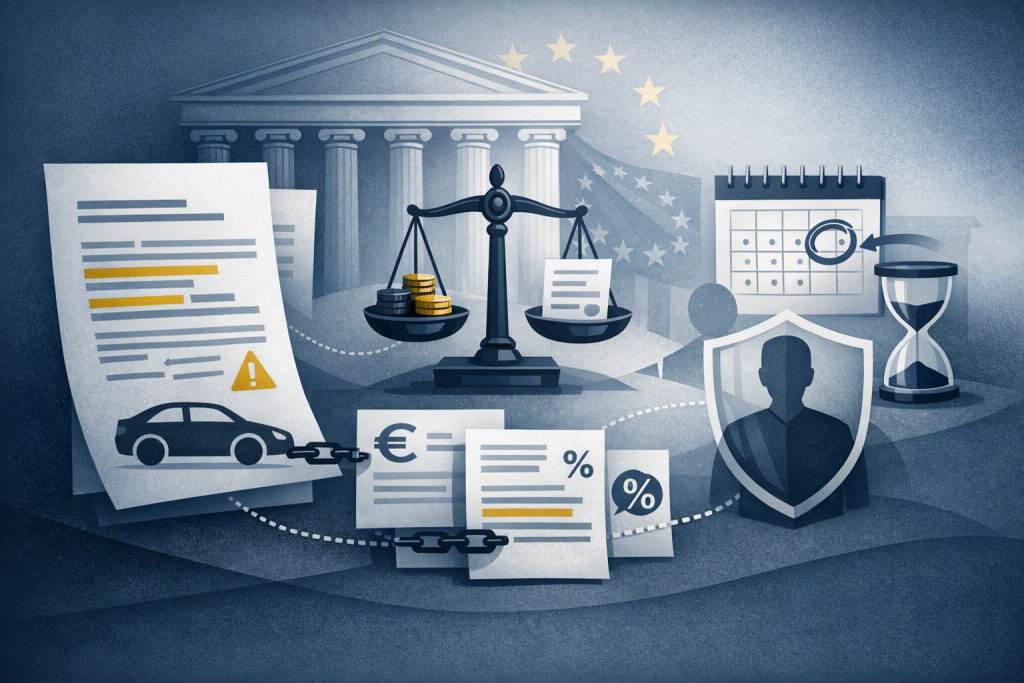
In preliminary ruling proceedings referred by the Regional Court of Ravensburg, the Court of Justice of the European Union ruled on the interpretation of Directive 2008/48/EC of 23 April 2008 on credit agreements for consumers and repealing Council Directive 87/102/EEC (judgment of 9 September 2021, C-33/20; C-155/20; C-187/20). The proceedings before the Regional Court concerned […]
Multiple Jobs Held by One Employee – Is It Lawful to Take on a Second Job?

I. Concurrent employment relationships As a general rule, the Hungarian Labour Code does not contain any prohibitive provision expressly excluding the possibility for an employee to be employed in several employment relationships at the same time — commonly referred to as a second job. It follows from the freedom to enter into employment relationships that […]
Covid-19: Risk of Liability for Damage Contrary to Good Morals in the Case of Trade Credit

In the current crisis caused by the Covid-19 virus, sole traders and company managing directors — despite the suspension of the obligation to file for insolvency — as well as persons responsible for the organisational liability of certain corporate bodies are not entirely out of danger, even in light of the limited measures introduced by […]
BREAKING: No Oral Hearings in Hungary

Pursuant to Government Decree No. 45/2020 (III.14), the government has ordered extraordinary court recesses. Measures are to be taken to prevent and respond to the mass epidemic that endangers the safety of life and property, and to protect the health and lives of Hungarian citizens. Accordingly, Hungarian courts will not hold oral hearings, preparatory hearings, […]
German Federal Court of Justice (BGH): Managing Directors of a German GmbH Do Not Owe a “Duty of Loyalty” to the GmbH’s Creditor

In its judgment delivered on 7 May 2019, the German Federal Court of Justice (Bundesgerichtshof, BGH) held that it is not possible to successfully pursue a damages claim against the managing director of a GmbH (German limited liability company) under Section 826 of the German Civil Code (BGB) for intentionally causing harm in a manner […]
EU E-Evidence Regulation Remains Uncertain

Greater criminal-law cooperation between EU Member States is the objective of the E-Evidence proposals. Whether this objective can be achieved, however, remains uncertain. Half a year after the proposal was introduced, the parties involved are still disputing the design of what may become a future EU regulation. The proposal, which concerns the securing of evidence […]
 English (UK)
 Magyar
 Deutsch
 Türkçe
 Español
 Català
 Русский