

What happens when a lawsuit is already pending, arguments have been exchanged, and a court decision is expected – and then the rules are changed overnight? In Hungary, we now have a clear answer.
–
The move
Three days ago, the Hungarian government adopted Government Decree No. 15/2026, explicitly stating that its provisions apply not only to future cases, but also to court proceedings already in progress.
This short section did the heavy lifting:
“Section 6 (1) The provisions of this decree shall also apply to court proceedings currently pending. (2) Any pending lawsuit relating to the solidarity contribution due for the years 2023–2025 shall be terminated by the court. The costs of the proceedings shall be borne by the State.”
That was it.
The “solidarity contribution” is a centrally imposed redistribution mechanism [= tax] that shifts significant resources from economically stronger — often opposition-led — cities to the state budget.
The result
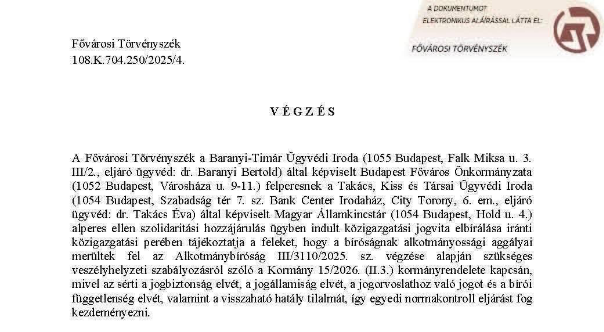
The Budapest-Capital Regional Court was hearing an ongoing case between the Municipality of Budapest and the Hungarian State Treasury when the new decree was adopted. Faced with the sudden change in the legal framework, the court concluded that it may no longer be able to decide the case on its merits. Instead, the court informed the parties that it is requesting constitutional review and, as a result, the proceedings have been put on hold.
In doing so, the court explicitly raised broader concerns about:
- retroactive regulation,
- legal certainty,
- the separation of powers, and
- the practical limits of judicial review when the executive intervenes mid-proceeding.
What’s next?
The case now moves to the Constitutional Court, which is required to decide within 90 days whether the challenged provisions are compatible with the constitutional guarantees of the Hungarian Constitution. At the same time, the court is also considering whether to initiate a preliminary ruling procedure before the Court of Justice of the European Union (CJEU), to examine whether the „solidarity contribution” may conflict with EU law, in particular the European Charter of Local Self-Government.
The outcome of these proceedings will determine whether the dispute can return to the ordinary courts for a decision on the merits – or whether legislative intervention will continue to block judicial review.
