

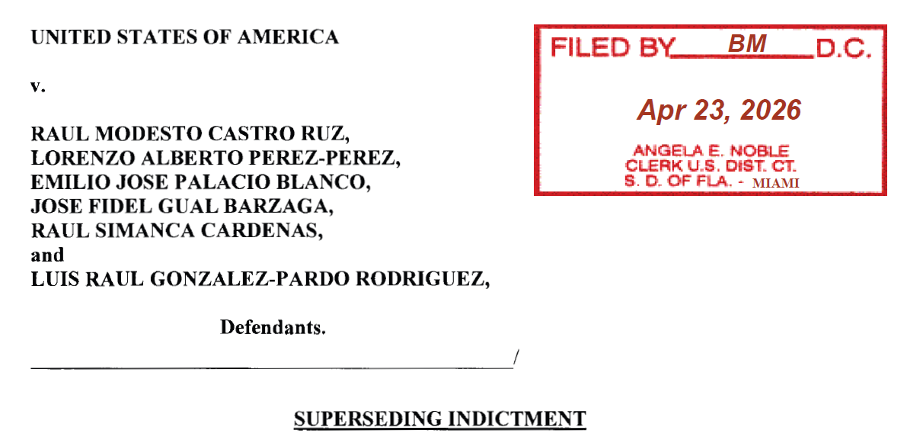
The superseding indictment filed in 2026 in connection with the 1996 shootdown of Brothers to the Rescue (BTTR) aircraft is a rare and complex example of the United States seeking to impose criminal liability for acts committed entirely outside its own territory.
BTTR is an activist nonprofit organization founded by Cuban exiles and based in Miami, Florida, known primarily for its opposition to the Cuban government and its former leader, Fidel Castro.
Who Is Charged and for What Conduct?
The indictment names former Cuban President Raul Modesto Castro Ruz and several Cuban fighter pilots as defendants. According to the indictment, the named individuals committed crimes against the state, destroyed civilian aircraft(s), and committed murder.
The central allegation is Count One: conspiracy to kill U.S. nationals (18 U.S.C. § 2332(b)(2)). According to the indictment, between January and April 1996, outside the territory of the United States, the defendants knowingly and intentionally agreed to kill U.S. citizens.
The indictment expressly states that the objective of the conspiratorial group was to use intelligence information to shoot down BTTR’s unarmed civilian aircraft in order to intimidate, deter, and retaliate against the activities of the Cuban population and its community in exile.
This allegation is supported, among other things, by the following:
- intelligence infiltration of the BTTR organization in Miami,
- military preparation and operational orders issued through the chain of command,
- and the execution of the attack on February 24, 1996, when two aircraft were destroyed with air-to-air missiles (AAMs) in international airspace, resulting in the deaths of four individuals.
The remaining counts include:
- Counts 2–3: destruction of aircraft (18 U.S.C. § 32, § 34; 49 U.S.C. § 46501), separately charged for each aircraft,
- Counts 4–7: murder (18 U.S.C. § 1111, § 3238, § 2), separately charged for each victim.
This structure allows the prosecution to address both the conspiratorial nature of the offenses and the individual killings, as well as destruction of civilian aircraft.
What Is the Basis for U.S. Extraterritorial Jurisdiction?
The key basis for U.S. jurisdiction is 18 U.S.C. § 2332(b), which expressly criminalizes the killing of U.S. nationals abroad or conspiracies to do so. A similar provision can be found in Section 3(2)(b) of the Hungarian Criminal Code, which provides that Hungarian criminal law applies to acts committed abroad by non-Hungarian nationals against Hungarian citizens if the conduct is punishable under Hungarian law.
This framework is based on several principles of jurisdiction:
- Passive personality principle – jurisdiction is based on the U.S. nationality of the victims;
- Protective principle – the location of the offense or the offender’s nationality is not determinative, allowing the state to prosecute conduct committed abroad by foreign nationals when state interests are affected, typically in crimes against the state, such as espionage;
- Special territorial principle – jurisdiction over aircraft registered in the United States; 49 U.S.C. § 46501 specifically defines the concept of “special aircraft jurisdiction.”
It is also important to note that, under 18 U.S.C. § 2332(d), the initiation of proceedings for extraterritorial offenses requires a determination by the Attorney General that the purpose of the offense was to intimidate, coerce, or retaliate against a government or civilian population. Similar to the Hungarian Criminal Code, this requirement demonstrates that many states treat criminal claims arising outside their territory not merely as jurisdictional matters, but as issues requiring foreign policy and sovereignty-based review.
Finally, 18 U.S.C. § 3238 establishes venue for such cases. As a general rule, proceedings must be brought in the district where the defendant is arrested or first brought. If that has not yet occurred—as in the present case—the indictment may be filed in Washington, D.C., in the absence of any U.S. residence of the defendants.
Issues of State Sovereignty and Immunity
Every case of this nature raises tension between state sovereignty and individual criminal responsibility.
1. State Sovereignty
A fundamental principle of international law is that a state primarily exercises sovereignty within its own territory. The indictment, however, relies on the allegation that the shootdown occurred in international airspace, thereby reducing the significance of exclusive territorial jurisdiction.
At the same time, the conduct was allegedly carried out by state organs, including the military and intelligence services, which would traditionally raise questions of state responsibility under international law. The U.S. proceedings instead deliberately focus on individual criminal liability.
2. Immunity of State Officials
The immunity of incumbent state leaders, such as heads of state or heads of government, is intended to ensure the smooth functioning of international relations and to protect sovereign equality. Functional immunity, by contrast, is based on the idea that the courts of one state should not sit in judgment over the sovereign acts of another state. It applies to acts performed in an official capacity or in the exercise of state authority and may continue even after the official leaves office.
The U.S. approach implicitly assumes that perpetrators of serious crimes—particularly attacks against civilians—do not necessarily benefit from functional immunity, and that criminal proceedings based on individual criminal responsibility are distinct from the international legal responsibility of the state itself.
From a practical standpoint, however, the enforceability of such proceedings ultimately depends on whether the defendants can be apprehended and brought within the jurisdiction of the United States.
Conclusion
The Castro case illustrates how U.S. law can transform the legal characterization of a politically sensitive incident involving state actors from an international conflict into a domestic criminal prosecution.
The case is based on:
- statutory provisions with extraterritorial effect,
- the nationality of the victims,
- the status of the aircraft or vessels involved,
- and the extension of liability to high-level decision-makers.
At the same time, the case also demonstrates that the tension between individual criminal accountability and state sovereignty remains unresolved, particularly with respect to the immunity of senior state officials.
